The iPhone Ultra’s real test is not the fold
Apple’s first foldable could become the screen that AI has been waiting for—or an exquisitely engineered answer to a question most people stopped asking.

Takeaways by Learning The World AI Show Hide
- The foldable iPhone will matter only if Apple turns its larger display into a new kind of workspace rather than merely a larger canvas.
- Generative AI increases the value of screen space because useful interaction requires comparison, inspection, editing and verification.
- Apple’s challenge is to prove that the reported $2,000-plus device is a new computing category, not simply its most expensive iPhone.
AI-generated from this article and reviewed by the editor.
Apple has spent the past decade making the iPhone better without making it fundamentally different.
The cameras improved. The chips accelerated. The screens brightened, the bezels retreated and the software accumulated abilities that would once have required a room full of specialised equipment. Yet the essential object remained almost perfectly stable: a black rectangle held in one hand, designed around one application occupying one screen.
The foldable iPhone may be the first serious attempt to break that settlement.
Apple has confirmed a special event for 9 September, while Bloomberg reports that the company is preparing to introduce its first foldable iPhone. “iPhone Ultra” is reportedly the name used inside Apple, although the company has not announced the product or confirmed what it will be called.
The usual questions are already consuming the technology press. How visible will the crease be? How thin will the device feel when closed? Will its hinge survive years of compulsive opening and shutting? How much will it cost, and how quickly will the first production run sell out?
Those are sensible questions. They may not be the important ones.
The real question is what happens when the world’s most influential personal computer gains a second physical state.
A conventional smartphone is built around substitution. Open one application and the previous one disappears. Tap a notification and your attention is transferred elsewhere. Even when the software allows multitasking, the display encourages a sequence of isolated activities: read, switch, respond, switch again.
That arrangement was tolerable when software mostly waited for instructions. It is becoming less adequate as AI systems begin to generate documents, interpret images, search across sources, operate tools and propose decisions.
Useful work with AI is rarely a clean conversation between a person and a chatbot. It is a process of comparison. The source sits beside the summary. The draft sits beside the prompt. The generated image sits beside the reference. The recommendation sits beside the evidence on which it supposedly rests.
On an ordinary phone, those relationships are hidden behind swipes and application changes. The interface continually removes the context needed to judge what the machine has done. An answer fills the screen; the evidence disappears beneath it. Fluency wins because verification is inconvenient.
A foldable display could change that.
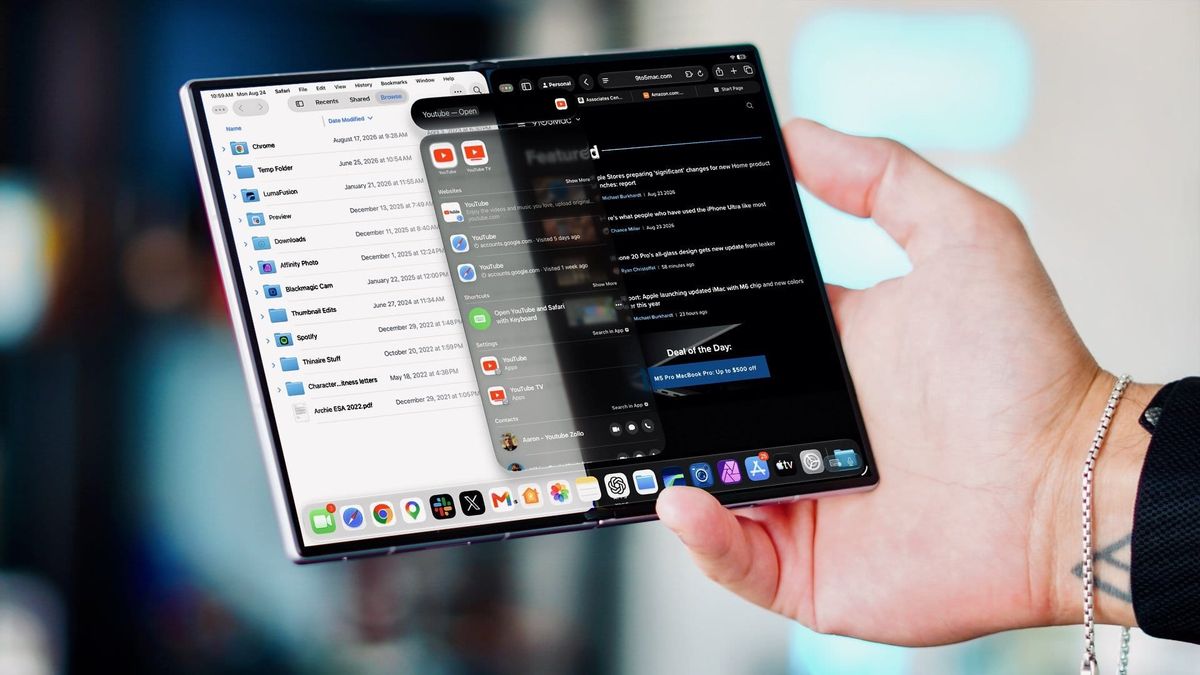
The reported design opens from a phone-sized outer display into something closer to a small tablet. Supply-chain analyst Ming-Chi Kuo has described a roughly 5.5-inch external screen and a 7.8-inch internal display, with a price above $2,000, in his original forecast for Apple’s foldable. None of those details is official, but they suggest a device intended to be more than a normal iPhone that happens to bend.
The larger screen could allow a user to place an AI system beside the material it is acting upon. A message could remain visible while the machine drafts a response. A photograph could sit next to the generated edit. A contract could occupy one side while an assistant identifies clauses on the other. A source could remain present while the model summarises it.
The shape of a screen determines which forms of thought feel natural. A narrow display privileges consumption, succession and reaction. A wider one allows comparison, composition and sustained attention. The difference is not simply how much information appears. It is whether relationships between pieces of information can remain visible.
This is why the foldable iPhone could become Apple’s most important AI product even if its artificial intelligence is not dramatically better than anyone else’s.
Apple entered the generative-AI era with an unusual problem. It controlled some of the most valuable interfaces in the world but did not control the technology changing what those interfaces were for. The first wave of chatbots arrived through familiar rectangles inside familiar applications. The model was new; the container was inherited.
The Ultra offers an opportunity to design the container around the model.
Reporting from Bloomberg indicates that iOS 27 includes enhancements intended for the foldable iPhone. That software will matter more than the hinge. Apple does not need to demonstrate that two applications can technically appear at once. Android foldables have offered versions of that idea for years. It must decide what a folding device is for.
If the answer is watching a larger video, viewing a larger webpage or stretching an ordinary iPhone application across more pixels, the Ultra will be an impressive indulgence. It may sell to enthusiasts, subsidised buyers and people who regard novelty as part of luxury. But it will not establish a new relationship with computing.
The stronger possibility is that opening the device changes its mode of operation.
Closed, it could remain a conventional phone: immediate, glanceable and personal. Open, it could become a workspace organised around an active context rather than a collection of applications. A document, conversation or project could become the stable object while AI services move around it—researching, generating, checking and transforming without forcing the user to surrender the underlying material.
That would make the fold meaningful. The physical action would mark a transition from checking to working, from receiving an answer to examining how it was produced.
Apple is unusually well positioned to attempt this because it controls the hardware, operating system, applications, silicon and much of the personal data architecture around the device. It can decide how an assistant accesses messages, files, photographs and calendars. It can make those permissions visible. It can design continuity between the outer and inner screens. It can determine whether AI activity appears as an opaque event or as a process the user can inspect and interrupt.
It can also get all of this wrong.
A larger display creates more room for AI, but also more room for AI theatre: glowing panels, unsolicited summaries and system-generated suggestions competing for attention. Apple may use the fold to place more software between people and the material they are trying to understand. The device could become a premium surface for answers that look authoritative while concealing their sources.
The price compounds that risk. IDC expects Apple’s entry to accelerate the entire foldable market and has forecast that the company could take 34 per cent of the category’s value in its first year, based on an estimated average selling price of about $2,400. Yet IDC also expects foldables to remain a niche in unit terms.
That makes the Ultra both a product and a declaration. Apple is not merely adding another phone to its range. It is proposing that the next stage of personal computing begins at the very top of the market.
Perhaps that is unavoidable. New forms usually arrive as expensive objects before their useful ideas move down the range. The original Macintosh was not a mass-market purchase. Neither was the first iPhone. Their significance came from making a different interaction model legible: the graphical desktop in one case, direct manipulation through touch in the other.
The foldable iPhone needs an equivalent idea.
Its achievement cannot simply be that Apple has built a hinge better than other companies’ hinges. The fold has to expose a new logic for the device—one suited to a period in which software does not merely display information but produces it, interprets it and increasingly acts upon it.
The most interesting thing about the iPhone Ultra, then, is not that its screen may fold.
It is that the familiar screen no longer appears sufficient.
For nearly twenty years, the smartphone taught us to experience the digital world through a succession of full-screen applications. AI is dissolving those boundaries. It crosses between messages, photographs, documents, searches and services. It asks for context, performs work across categories and produces material that must be judged against whatever came before it.
The rectangle is beginning to strain under the intelligence being placed inside it.
Apple’s foldable will not solve that problem merely by becoming wider. But if the company understands what the extra space is for, opening the Ultra could reveal more than another screen.
It could reveal the first interface designed for the difficult work of thinking alongside machines.
Picking up my pre-order Vision Pro at 9am on 28 June 2024 at the Orchard Road Apple Store in Singapore. I was delighted to play my small role in Apple's press release later that day. I intend to do the same for the pre-order of the foldable iPhone Ultra next month.… pic.twitter.com/DH6jrVse5k
— Michael de Waal-Montgomery (@michaeldwm) August 29, 2026
This AI generated iPhone Fold concept video is seriously impressive 🤯
— Fernando Silva (@nandoprince93) August 26, 2026
Even the way the iPhone expands to reveal the display internals feels incredibly Apple-like lol
Would you buy an iPhone Fold if it looked like this? 👀 pic.twitter.com/6J35G8biOZ