Samsung’s Galaxy Z TriFold remains sold out after its limited run
The $2,899 dual-hinged phone unfolded into a 10-inch tablet, but Samsung stopped regular sales after three months and cleared the final US stock in April.

Takeaways by Learning The World AI Show Hide
- Samsung’s $2,899 Galaxy Z TriFold opened from a 6.5-inch phone into a 10-inch tablet and was sold only in limited quantities.
- Samsung began winding down sales after roughly three months and its official US page now says the limited run is completely sold out.
- Reviews praised its large-screen multitasking and standalone DeX, but its weight, price and design compromises kept it closer to a technology showcase than a mainstream phone.
AI-generated from this article and reviewed by the editor.
Samsung’s Galaxy Z TriFold is no longer a normally available retail phone. Samsung’s official US product page says the limited run is completely sold out, with no new inventory announced.
Samsung unveiled its first dual-hinged Galaxy phone in December 2025. It went on sale in South Korea on 12 December, followed by China, Taiwan, Singapore and the United Arab Emirates, before reaching the United States on 30 January 2026.
The US model cost $2,899 and came in Crafted Black with 512GB of storage. Samsung sold it through its website and Experience Stores rather than through the broad carrier and retail network used for mainstream Galaxy phones.
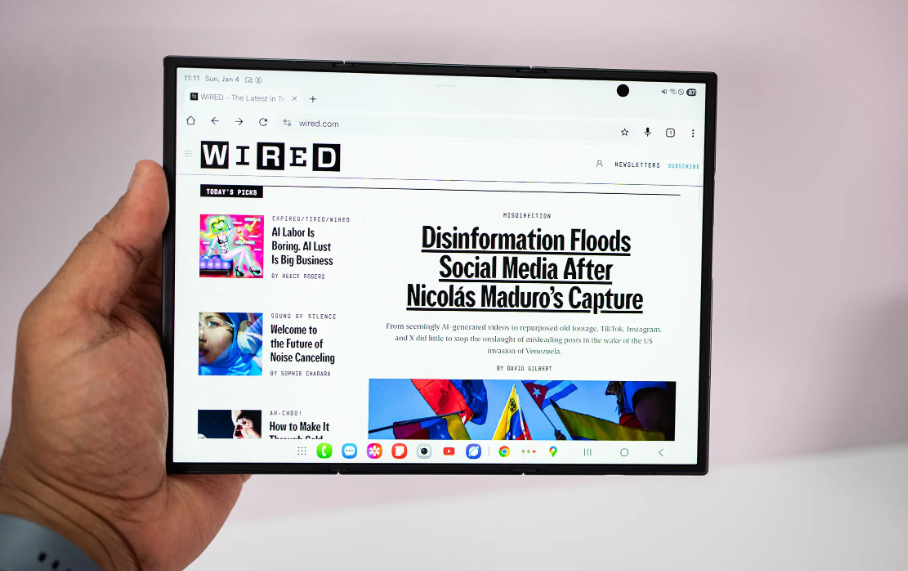
Closed, the TriFold worked as a 6.5-inch phone. Two inward-folding hinges opened it into a 10-inch, 2160-by-1584-pixel display. It weighed 309 grams and measured 12.9mm when folded, while its thinnest panel was 3.9mm when open.
Samsung equipped the phone with a Snapdragon 8 Elite for Galaxy processor, 16GB of memory, a 5,600mAh battery and a 200-megapixel main camera. Its more distinctive feature was the workspace: users could run three portrait-sized apps side by side or launch Samsung DeX directly on the phone without an external display.
Reviews generally agreed on the trade-off. HardwareZone praised the large display and multitasking but noted the weight, visible creases and missing features such as FlexCam. Bloomberg found the expanded screen useful, but concluded that the TriFold remained an expensive, over-engineered experiment rather than a replacement for a tablet or laptop.
The retail window was brief. Bloomberg reported on 17 March that Samsung would stop selling the device in South Korea and discontinue it in the United States after clearing the remaining inventory. A company spokesperson described the TriFold as a limited-quantity, super-premium device intended to showcase new technology.
The final US restock arrived on 10 April. A week later, Samsung’s listing said the limited run was completely sold out online and in stores.
The sellouts do not by themselves establish mass-market demand because Samsung never disclosed a large production run. They do show that a small audience was willing to pay nearly $3,000 for a device that turned a conventional phone into a larger workspace.
For now, the TriFold is best understood as a finished hardware trial rather than an active product line. It demonstrated that Samsung could fit a 10-inch screen into a pocketable dual-hinged design, while its price, weight and short sales window showed how far the format remains from an ordinary flagship phone.