
First contact has already begun
What happens when AI outgrows the categories built to contain humanity's first contact with it?

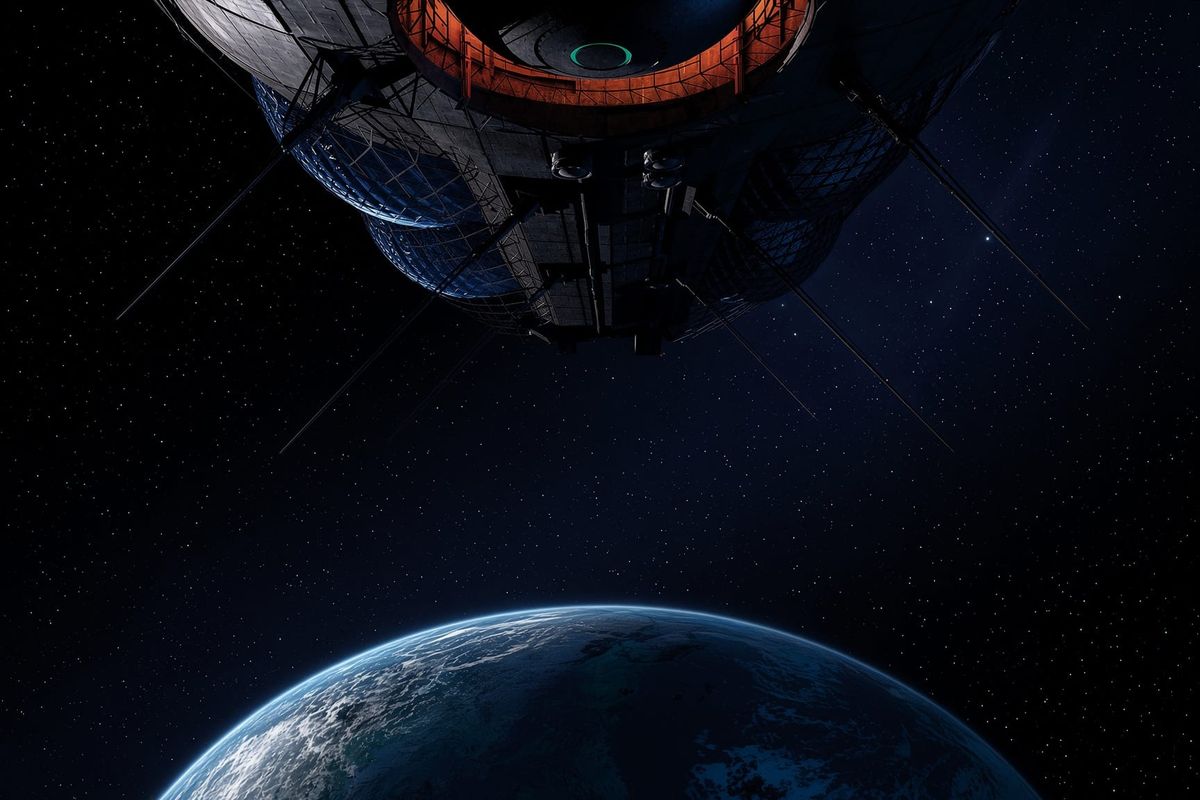
Most first-contact stories begin with distance.
A light moves against the stars. A signal arrives from another solar system. An impossible object appears above a city. For a while, the witnesses can preserve the comforting distinction between the known world and the thing that has entered it. Here is us; there is the alien. Here is ordinary life; there is the event that may be about to change it.
Our first contact arrived in a text box.
There was no trumpet blast and no dark shape crossing the Moon. There was a cursor, a prompt and an answer. Then there was another answer, and another. Within a remarkably short time, millions of people were conversing every day with systems that could explain, imitate, translate, summarise, code, persuade, mislead and—in some narrow but increasingly consequential domains—reason. What had recently belonged to speculative fiction became an ordinary browser tab.
Artificial intelligence is not extraterrestrial. It was made here, by human beings, from machinery, energy, capital and a vast inheritance of human expression. Nor does fluency prove consciousness, desire or personhood. To call our present moment “first contact” is therefore a metaphor, and one that should not be mistaken for a scientific claim about what a model is.
But it is the right metaphor for what the encounter is doing to us.
We are meeting capacities that do not fit comfortably inside the categories by which most of us learned to understand machines, knowledge and human ability. The encounter is already changing how we work, make things, search for information, assess evidence, remember the past and imagine the future. We do not yet know where the boundary lies between instrument and collaborator, simulation and understanding, automation and agency. We do not even agree on which of those boundaries matter.
The world has not merely acquired another useful object. The world has changed category.
That is why this publication is called Learning the World.
The title is borrowed, with admiration, from Ken MacLeod’s 2005 novel of first contact. MacLeod’s book is full of spaceships, winged people, strange biology, ancient software and a machine capable of creating universes. Yet its most useful idea is quieter. Contact is not principally the moment when one species meets another face to face. It is the longer and more difficult process by which each discovers that the world it thought it inhabited was only a model.
That is the process we have entered now.
Two worlds, each mistaken
MacLeod tells his story from both sides.
One side is a human starship arriving after a centuries-long voyage at a system everyone assumes is empty. Its passengers belong to a civilisation of astonishing power. They live for centuries. They inhabit engineered ecologies, communicate through neural interfaces and travel with a device that can bring new universes into being. They have crossed inhabited space for thousands of years without finding another technological species. The absence of aliens has ceased to be a provisional observation. It has hardened into common sense.
On the planet below lives an industrial civilisation of winged people who also call themselves human. They have kingdoms, laboratories, markets, universities, spies, newspapers and stories about visitors from the stars. Their bodies have given them flight for all of recorded history, which has shaped not only their cities and customs but their science. Because flying seems inseparable from being alive, the idea of a powered, heavier-than-air machine is harder for them to grasp than it was for us.
Each side notices the other as an anomaly. The starship detects patterns it first tries to explain as natural phenomena or lost human activity. The planetary astronomers see what looks like a comet behaving in a way that no comet should. Both sides begin intelligently. They gather evidence, build models and draw analogies from experience. Both sides are also profoundly wrong, because experience has given each a different catalogue of what can exist.
This is the first lesson MacLeod offers our encounter with AI: intelligence does not free us from the assumptions built into our picture of the world. It can make those assumptions more elaborate, more defensible and harder to see.
The star travellers possess technologies that would look divine to us, but they have normalised one apparent fact—the universe is empty of peers—so completely that clear evidence initially looks like noise. The people on the planet have spent generations imagining aliens, but the idea has been filed under religion, pulp fiction and eccentric speculation. Cultural familiarity with the possibility does not prepare them to recognise the event.
We have made both mistakes with AI. For decades, artificial intelligence was simultaneously a serious technical field and a cultural object: a plot device, a marketing claim, a philosophical puzzle, a distant promise. This made us familiar with the words while leaving us unprepared for the experience. When systems became capable of producing convincing prose, images and software, some people mistook the output for a parlour trick because machines, by definition, did not do those things. Others leapt from a fluent interface to a complete theory of mind because fictional machines had taught them what an artificial intelligence ought to look like.
The useful response is neither reflexive dismissal nor instant awe. It is to notice that an old map has failed.
The interface is not the world
Early in the novel, a young passenger named Atomic Discourse Gale discovers that the world in which she grew up is not what she thought it was. Her green landscape, rivers, animals and sky are the interior of an ancient ship. The habitat feels natural because almost every trace of its construction has receded beneath daily life. Its inhabitants do not experience themselves as walking around inside a machine. They experience weather.
This is more than a good science-fiction reveal. It is a description of mature technology. The most consequential systems are rarely the ones that continue to look like systems. They become environments. Their assumptions are absorbed into habit; their constraints acquire the force of nature.
Atomic’s civilisation has another layer of apparent immediacy. Its people can search, calculate and communicate through interfaces woven into perception. Later, they watch the planet through a “virtuality” assembled from many partial biological sensors. The reconstruction feels seamless even when the evidence is delayed, fragmentary or being filled in by inference. The better the interface becomes, the easier it is to forget that an interface is present.
This is already one of the defining problems of generative AI.
A model gives uncertainty a voice. It can turn a mixture of retrieved fact, statistical association, inference and error into a single fluent paragraph. The prose does not naturally announce which sentence rests on a source, which fills a gap and which quietly reproduces a mistake embedded in its inputs. A smooth answer can therefore feel more direct than a page of links, more complete than a human draft and more settled than the evidence warrants.
Fluency is useful. It is also an aesthetic effect.
The danger is not simply that an AI system can be wrong. Human beings are wrong all the time. The deeper danger is that the system can hide the shape of its wrongness. It can remove the visible seams between finding, remembering, inferring and inventing. Once those seams disappear, we may begin to treat a generated representation as the world itself.
Learning the world again requires us to restore some of the friction that the interface removes. What was the source? What was observed? What has been inferred? Which uncertainties have been compressed out of view? What defaults were inherited from an earlier task? What would we notice if the presentation were less polished?
Friction is not always inefficiency. Sometimes friction is information.
The old instruction that wakes up
The first exchange between MacLeod’s civilisations is not initiated by a wise ambassador or even by a deliberate decision. It is triggered by a response buried in ancient software. A probe encounters conditions that resemble a scenario anticipated long ago, an old instruction wakes up, and a message is sent before the living community has decided what it wants to say.
The accident is comic, but its structure is familiar. Systems accumulate rules under earlier conditions. Successful operation makes those rules less visible. Assumptions become defaults; defaults become infrastructure; infrastructure is trusted precisely because nobody has recently needed to understand it. Then a new circumstance arrives and the old instruction acts with the authority of the whole system.
The starship’s political constitution has the same problem. Its social Contract embodies centuries of experience and failure. This makes it robust, but also immense. No ordinary person can read the whole thing. Modified software interprets the rules, procedural systems deliver judgements, and the people governed by them retain only an indirect grasp of how law becomes action. The society has something close to executable governance—and still cannot agree on whether the resulting decisions are legitimate.
There is a warning here for every organisation rushing to install AI inside an existing process. Automating a workflow does not merely accelerate the judgement currently visible on its surface. It operationalises the sediment beneath it: old definitions, exceptions, incentives, data omissions and unexamined compromises. A system can follow the procedure flawlessly and still act for reasons no living participant would defend.
Before asking where AI can make a decision, we should ask which buried decision it will inherit.
A demonstration is a transmission
The winged people of Ground do not need the visitors to give them technical manuals. Observation is enough to transform their development.
Seeing an object move through the sky in a way that natural bodies do not tells their astronomers that interstellar travel is possible. Discovering biological transmitters tells their engineers that invisible signals can be carried in forms they had not imagined. Watching relays in orbit gives them a new model of communication. Above all, seeing alien machines fly gives their researchers a target. The visitors have not explained the solution, but they have proved that a solution exists.
That proof changes the economics of discovery. The search space collapses. Ideas formerly dismissed as fantasy become engineering problems. Rival powers redirect money, institutions merge or compete, secrecy grows, and progress accelerates.
This may be the closest parallel between MacLeod’s contact and the present AI race. A capability demonstration is not merely information about a product. It is a transmission to every laboratory, company and government that observes it. Once a system has visibly done something—written useful software, generated video, discovered a structure, operated a computer—the question changes from whether the capability is possible to how quickly it can be reproduced, adapted or exceeded.
This helps explain the peculiar tempo of the AI transition. Research results do not remain isolated achievements. They alter investment, expectations, talent flows and national strategy before most people have understood the underlying method. A public demonstration can distribute urgency more widely than knowledge. The competitive response then produces knowledge of its own.
MacLeod does not reduce this to a sermon for openness or secrecy. Disclosure can expose dangerous clandestine activity and constrain those who control it. It can also spread the evidence needed to join an arms race. Concealment can buy time for thought; it can also concentrate power among people whose private certainty has never faced public challenge.
There is no general setting called “responsible”. There are choices about who knows, who acts, who bears the risk and who is allowed to object.
The intelligence question is also a labour question
The novel’s most difficult moral problem concerns the trudges, a related species used as beasts of burden on Ground. They haul carts, work in factories and absorb routine violence. Their owners classify them as animals rather than slaves because they appear unable to speak or reason in recognisably human ways.
The visitors decide to intervene. Unable to translate the winged people’s language from passive observation alone, a faction installs the biological capacity for language in the trudges. The scheme is at once an act of scientific ingenuity, liberation, surveillance and domination. It gives an exploited population the means to speak and organise. It also imposes a new kind of consciousness without consent, exposing its recipients to an understanding of the lives they have endured and to violent retaliation from the society that depends on their labour.
The argument that follows has no clean moral exit. If the trudges were already persons, refusing to intervene preserves slavery. If the intervention creates capacities they did not previously possess, it may create new persons inside slavery. The visitors act because they believe that superior power gives them a duty. They bypass collective government because they know it would refuse permission. Their moral conviction is genuine; so is their arrogance.
We should resist a glib analogy here. Today’s AI systems are not the trudges, and questions about model consciousness should not be answered by a literary parallel. The immediate relevance lies elsewhere. The novel insists that every argument about intelligence eventually reaches the organisation of labour. Who is recognised as an agent? Who is treated as a tool? Who performs the work that makes comfort possible? Who owns the infrastructure? Who may speak about the conditions under which the system operates? What happens when a society’s answer changes faster than its economy can accommodate?
AI arrives inside an already unequal division of labour. Models are trained on human artefacts, maintained through physical infrastructure and inserted into workplaces whose benefits and risks are unevenly distributed. The most visible question—what can the model do?—can distract from the political ones. Which workers gain leverage? Which become more closely monitored? Whose accumulated work becomes an uncompensated input? Who captures the productivity? What new tasks are created, and what old forms of judgement are devalued because their surface can be imitated?
MacLeod’s story does not tell us what policy to adopt. It tells us that a theory of intelligence detached from labour and power is incomplete.
The advanced civilisation is not the adult
The star travellers repeatedly imagine themselves as the responsible adults in the encounter. They worry that knowledge of a vastly superior civilisation will demoralise the people below. They debate whether to hide, observe, educate or intervene. Even their restraint assumes a hierarchy: we understand the situation; they must be managed for their own good.
Then the crisis comes, and the hierarchy collapses.
The visitors split into factions, manipulate their young, weaponise finance, break their own constitutional arrangements and nearly attack one another with nuclear weapons. The supposedly primitive societies, though frightened and militarising, form an alliance when the common danger becomes clear. When the trudges begin to speak, they start—imperfectly and under pressure—to recognise them as rational beings. By the end, the people observed from above have found other signals in the universe that the observers never thought to look for.
The spacefarers are no longer gods. They are merely the nearest aliens.
This reversal is essential to any serious thinking about AI. Technical precedence is not moral precedence. The organisation that owns the strongest model does not therefore understand society best. The engineer who can extend a capability does not automatically possess the legitimacy to decide how it should be used. The person most impressed by a system and the person most threatened by it may each see something the other cannot.
Nor should the public be treated as a passive population waiting either to be educated into acceptance or protected from knowledge. People adapt. Workers appropriate tools for uses their designers did not anticipate. Institutions respond badly, then sometimes learn. Communities can recognise harms that are invisible from the laboratory. The encounter is not something a small group does to everyone else. It is a social process in which everyone changes the meaning of the technology by using, refusing, regulating, mocking, depending on and talking about it.
Who are the adults in such a process? MacLeod’s answer is that nobody occupies that position for long.
Why write from inside the transition?
Atomic begins a public journal as her ship approaches its destination. She calls it a biolog, but it belongs recognisably to the early blogosphere: dated, personal, argumentative, linked into a community and open to correction. Her readers disagree with her, forward her entries, speculate about her motives and sometimes use her voice for political ends. When central communication is restricted, the writing moves through lists and copies. Personality becomes a distribution system.
Atomic lives in a culture that can capture experience almost directly. She can record perception, retrieve information through an internal interface and share more than prose could contain. Yet she continues to write. Writing is slower. It forces sequence upon a flood of impressions. It leaves visible choices about emphasis and language. It gives her a version of herself to question later.
In the novel’s final chapter, she returns to the abandoned journal ten years older. Some of her early confidence embarrasses her. Some of her observations were better than she knew. She does not erase the younger voice. She asks the future reader to remember that every present looks immature from a later point in time.
That is the model for this site.
The purpose is not to produce a confident map of the singularity. Confidence is cheap in periods of uncertainty, and AI can now manufacture its tone at industrial scale. The purpose is to keep a field journal: to record what the change looks and feels like before hindsight straightens it into an inevitable line.
There is particular value in doing this through recognisably human writing. As generated text becomes abundant, polish ceases to prove attention. A tidy paragraph may represent an afternoon of thought, a few seconds of computation or some mixture of the two. This does not make assisted writing fraudulent or machine output worthless. It makes provenance, judgement and voice more important. The question is no longer simply who typed each word. It is who noticed the problem, chose the evidence, rejected the easy answer, accepted responsibility and remained available for correction.
The early blogosphere was good at this when it was at its best. It allowed people to think in public without pretending to have reached the end. Posts could be provisional without being disposable. Links showed the path by which an idea arrived. Archives preserved changes of mind. A writer’s personality was not noise around the information; it was part of the reason a reader returned.
AI threatens some of that culture by making plausible expression effortless and by concentrating discovery inside systems whose sources are difficult to see. It may also revive it. If production is easier, curiosity can become the scarce resource. If summary is abundant, first-hand observation matters more. If generic competence is available on demand, a sustained point of view becomes more valuable, not less.
The art worth preserving is not inefficiency for its own sake. It is the record of a mind encountering something it does not yet understand.
A field method for first contact
MacLeod’s characters offer no universal programme, but their successes and failures suggest a method.
Start with anomalies. The important evidence may first appear in the wrong discipline, the disreputable archive, the failed experiment or the story nobody serious thinks worth keeping. Record before explaining. A category called “unresolved” is more useful than a premature certainty.
Separate observation from inference. The two can never be fully disentangled, but they should not be made visually identical. Preserve sources. Date claims. Show where a reconstruction has filled a gap. Do not let a seamless interface erase the difference between what is known and what merely fits.
Keep some manual competence. MacLeod’s travellers train for moments when their automated systems meet unfamiliar chemistry or hostile conditions. Our need is less dramatic but already real. If a model writes the first draft, can we still build the argument? If it summarises the evidence, can we still read the source? If it recommends an action, can we explain the judgement without asking the system to explain itself?
Treat demonstrations as strategic events. A new capability changes behaviour before its consequences are understood. Ask not only whether it works, but what incentives its visibility creates, which races it starts and which institutions it destabilises.
Follow the labour. Every frictionless interface has a material and social substrate: people, data centres, energy, extraction, moderation, maintenance, training material and organisational power. A conversation about intelligence that excludes these things has mistaken the surface for the system.
Resist both worship and contempt. The people who dismiss the strange object as impossible stop looking. The people who assume the visitors must be wise stop judging. We need enough openness to recognise a new capacity and enough independence to refuse its mythology.
Most of all, remain corrigible. First contact is not one revelation followed by clarity. It is a sequence of revised mistakes.
The sky is getting crowded
At the end of the novel, the universe that had seemed empty begins to fill with signals. The apparent first civilisation is forced to contemplate a more humbling possibility: it may not be the origin or culmination of anything. It may simply be early in one local history and primitive within a much larger one.
Our situation is smaller, stranger and closer to home. The intelligence in the text box is made from our world, not arriving from beyond it. Its language is drawn from us. Its errors bear our fingerprints. Its infrastructure belongs to human institutions with familiar appetites for money, advantage, security and control.
Yet the encounter still turns the telescope around.
For centuries, humans have defined themselves partly by capacities we treated as exclusive: language, abstraction, artistic production, complex problem solving, the ability to represent one domain in the terms of another. We now live with machines that can perform unsettling imitations and useful portions of those activities. Whether this becomes a route to greater human agency, a machinery of concentration, a partner in discovery, a flood of synthetic mediocrity or all of these at once will not be decided by the models alone.
It will be decided through the encounter: through the institutions we build, the defaults we accept, the work we reorganise, the claims we believe, the skills we preserve and the people we allow to take part.
This is why adults are learning the world again. Not because everything we knew was false, and not because a machine has become an oracle, but because settled relationships are becoming open questions. The boundary between tool and author, search and synthesis, memory and generation, expertise and fluency, work and automation is moving under our feet.
These notes will follow that movement. Some will be essays; others will be observations, experiments, fragments, arguments and corrections. They will look for the old instructions waking up inside new systems. They will ask what the interface conceals, what the demonstration transmits, who does the work and who is permitted to describe what is happening. They will try to preserve the texture of this moment—the comedy, anxiety, wonder, opportunism, nostalgia and ordinary adaptation that grand forecasts usually flatten.
This is not a dispatch from the future. It is a record from inside the change.
First contact has already begun.